Behind the Development of Sensor Technology at Tasowheel
How We Develop New Sensor Technologies
Sensors are the foundation of any online quality control system. Here at Tasowheel, they are not only measurement devices but long-term investments, designed to operate reliably in some of the most demanding industrial environments, around the clock, year after year.
To explain how new sensor technologies are developed, we turn to our R&D sensor team. Together, we offer a behind-the-scenes view of how ideas move from market needs to field-proven solutions.
Development Driven by Real Needs
At Tasowheel, sensor development always starts with the market. According to Senior Product Manager Joakim Stenius, the first question is never about technology for its own sake.
Sensors are the cornerstone of a QCS system, but not every idea becomes a development project. The team evaluates whether customers actually need a new measurement, whether Tasowheel has the core competence to develop it, and whether the investment makes sense over the sensor’s long lifecycle. In some cases, development is driven by necessity rather than opportunity: electronic components become obsolete, or faster signal response is required, forcing redesigns or technology upgrades.
There is also a strategic dimension. To be credible in the markets where Tasowheel operates, certain core sensors must be part of the portfolio. Incremental development, upgrading components and extending product lifecycles, is therefore just as important as creating entirely new sensors.
Senior Product Manager Jussi Graeffe adds that Tasowheel focuses on continuously improving essential measurements such as basis weight, moisture, ash, and caliper, while also developing new sensors where clear future demand is emerging. The goal is to cover the most critical process challenges, while selectively investing in specialized technologies that open new market opportunities.

When Is a Sensor “Ready”?
The concept of “finished” rarely applies to sensor development. Requirements evolve, new components enter the market, and customer expectations continue to rise. A sensor may be upgraded to add value, but sometimes redesigns are unavoidable simply because components are no longer available.
Jussi Graeffe explains that readiness is validated through prototypes and pilot sensors that are brought into real online environments as early as possible. If performance meets expectations, production begins. If not, the pilot phase provides critical insight into what must be improved. Even after release, development continues through incremental enhancements informed by field experience.

Designing for Harsh Reality
Paper and board production environments place extreme demands on measurement systems. High temperatures, humidity, aggressive chemicals, vibration, and noise are constant challenges. At the same time, QCS systems are expected to operate continuously, with minimal downtime.
In many mills, production depends entirely on the QCS. If one component fails, the entire system may be affected. This reality places exceptionally high demands on sensor reliability and component quality.
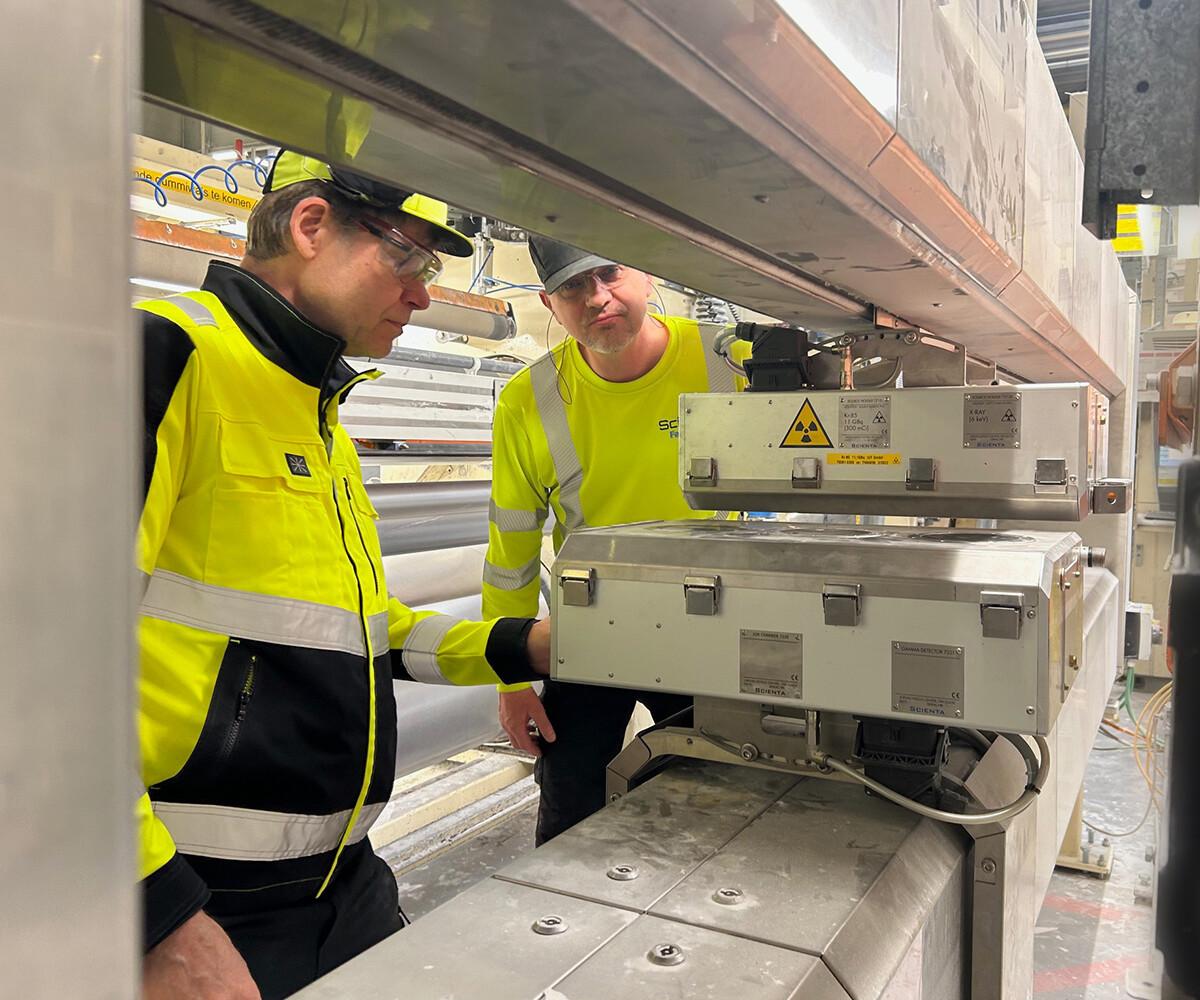
Design Engineer Teemu Niskanen describes the design team’s role as bridging the gap between laboratory concepts and mill reality. Mechanical designs must protect sensitive measurement components while maintaining accuracy and allowing easy access for maintenance. His experience performing field maintenance on the same equipment he designs has reinforced the importance of serviceability alongside robustness. Even small design changes can have a major impact. In one example, a minor adjustment to geometry and material selection in a rotating mechanism significantly reduced bearing loads, extending operational lifetime dramatically. These are the kinds of improvements that often make the difference between a design that works in theory and one that succeeds in the field
Customers as Development Partners
Customer collaboration plays a critical role in refining and validating new sensor technologies. The level of involvement depends on the potential process benefit, but customer expertise is often essential.
In some industries, for example, non-nuclear measurement technologies offer clear advantages over traditional radioactive solutions due to safety, environmental, and lifecycle considerations. Customers also contribute by providing laboratory reference data and supporting sensor adjustments after installation, helping ensure that measurements perform as expected over time.
Their expectations are high, but so is their willingness to collaborate when the measurement delivers real value.

Software: From Data to Insight
Behind every reliable measurement is a substantial amount of software. Senior Software Engineer Tapio Karinsalo explains that software plays an increasingly important role in sensor development. Signal processing and machine learning enable raw data not only to be measured but also interpreted directly at the sensor level.
The most critical interaction between hardware and software happens at the firmware level, where sampling, timing, calibration, and error detection are tightly linked to hardware behavior. Beyond that, software architecture becomes more flexible, enabling different platforms and technologies to be used efficiently.
Reliability is built in from the beginning. From design choices and firmware implementation to data validation, filtering, and continuous field monitoring, software ensures that sensor data remains trustworthy in real operating conditions.
Looking Ahead
Several trends are shaping the future of sensor development. Advances in detector materials, electronics, and computing power continue to expand what is possible. The push toward non-nuclear measurement technologies is also gaining momentum.
Software is playing an increasingly central role. Machine learning, over-the-air updates, digital twins, and simulation tools are accelerating development and improving long-term maintainability. At the same time, cybersecurity and reliability are becoming fundamental requirements rather than optional features.
As our experts make clear, sensor development at Tasowheel is not about chasing technology trends, it is about combining market needs, engineering discipline, and long-term thinking to deliver measurements customers can rely on, day after day.